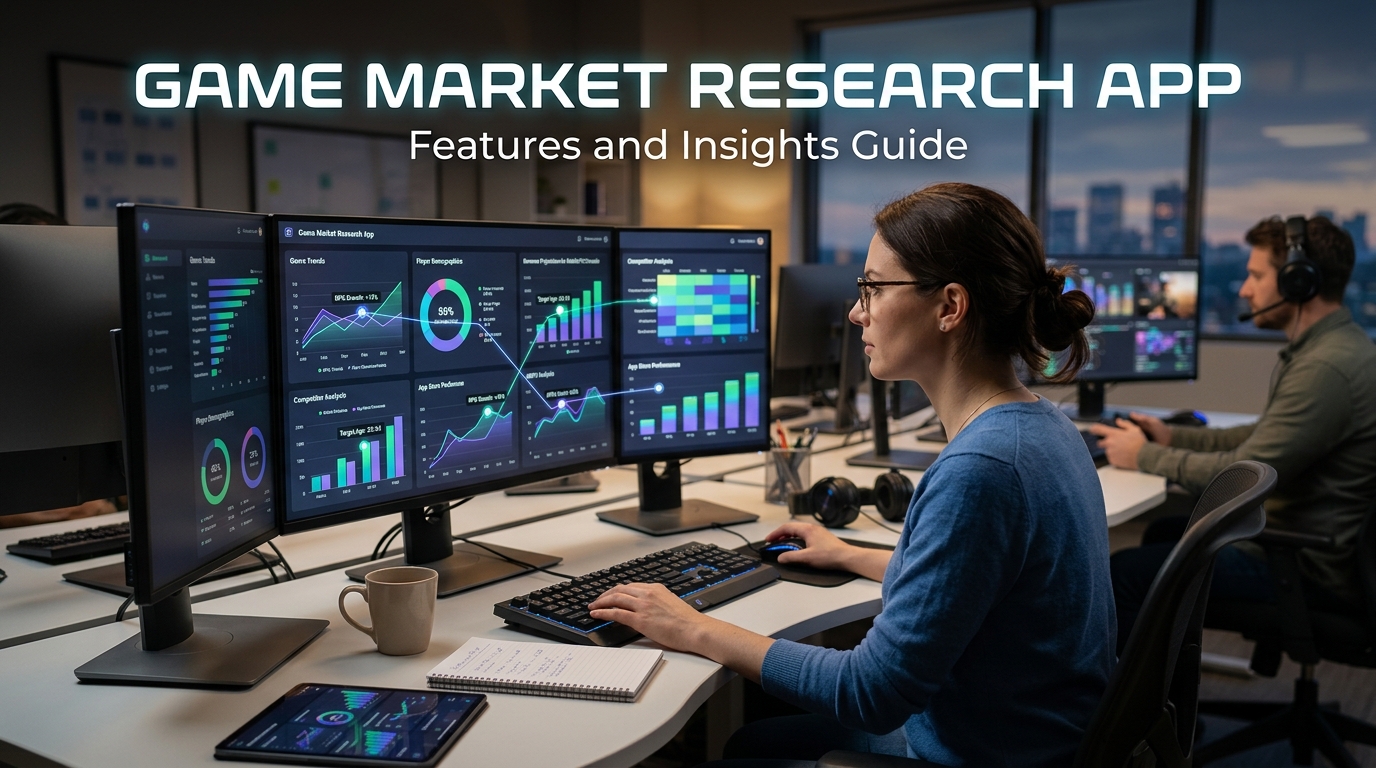
A Game Market Research App helps teams read app-store demand, competitor behavior, and user signals early, so product, marketing, and publishing decisions become clearer, faster, and less risky.
A Game Market Research App helps teams make better decisions before they spend money on creative, user acquisition, or a new launch. In practice, that means turning store signals, category movement, and competitor performance into a picture that is easier to act on. Sensor Tower’s platform describes mobile market intelligence in terms of downloads, revenue, active users, sessions, time spent, keyword rankings, ratings, reviews, and search ads, which shows how broad the modern research layer can be.
A Game Market Research App is valuable because game markets move quickly. A title can jump in visibility, fall after a bad update, or shift performance across regions in a way that is hard to see from one metric alone. Apple says App Store analytics help measure how people discover and interact with apps and games, while Google Play Console statistics let developers query, explore, and compare metrics from across Play Console. That kind of visibility is the foundation of smarter planning.
A Game Market Research App also supports the human side of decision-making. Teams often want reassurance before they commit to a theme, a feature, or a launch window. The right research view reduces that anxiety because it shows what users are doing instead of forcing the team to rely on intuition alone. When evidence is easier to see, strategy feels less like guessing and more like steering.
A Game Market Research App is not only for large publishers. Indie teams, UA marketers, and product managers all benefit when the app surfaces the same core question: what is happening now, and why? Apple’s App Store Connect and Google Play Console both emphasize performance analysis, while third-party platforms focus on market share, rankings, and competitive analysis. That combination makes the category useful for teams of any size.
What the best research tools actually measure
A Game Market Research App should measure more than raw downloads. Downloads matter, but they do not explain whether the audience stays, spends, shares, or returns. Sensor Tower highlights revenue, RPD, active users, sessions, and time spent as part of its App Performance Insights, which is a good reminder that market research is stronger when it connects acquisition with engagement and monetization.
A Game Market Research App should also show discovery behavior. Apple’s metrics definitions note that App Store metrics include impressions, product page views, and conversion rate, which helps teams understand how people move from search to page to download. That path matters because a game can have strong awareness but weak conversion if the store page is not convincing enough.
A Game Market Research App becomes much more useful when it includes review and rating patterns. A few isolated reviews are not enough, but trends across many users can point to friction in onboarding, monetization, or gameplay balance. Sensor Tower explicitly lists app ratings and reviews as part of its performance insights, which shows how sentiment fits naturally into market research rather than existing as a separate afterthought.
A Game Market Research App should also reveal where the data comes from. A platform is more trustworthy when it explains whether the numbers reflect store analytics, estimate models, or published reports. Sensor Tower describes a platform that combines app data, digital advertising insights, and audience analysis in one place, while Apple and Google each provide their own first-party analytics environments. Source clarity helps teams interpret results with more confidence.
App store analytics and platform differences
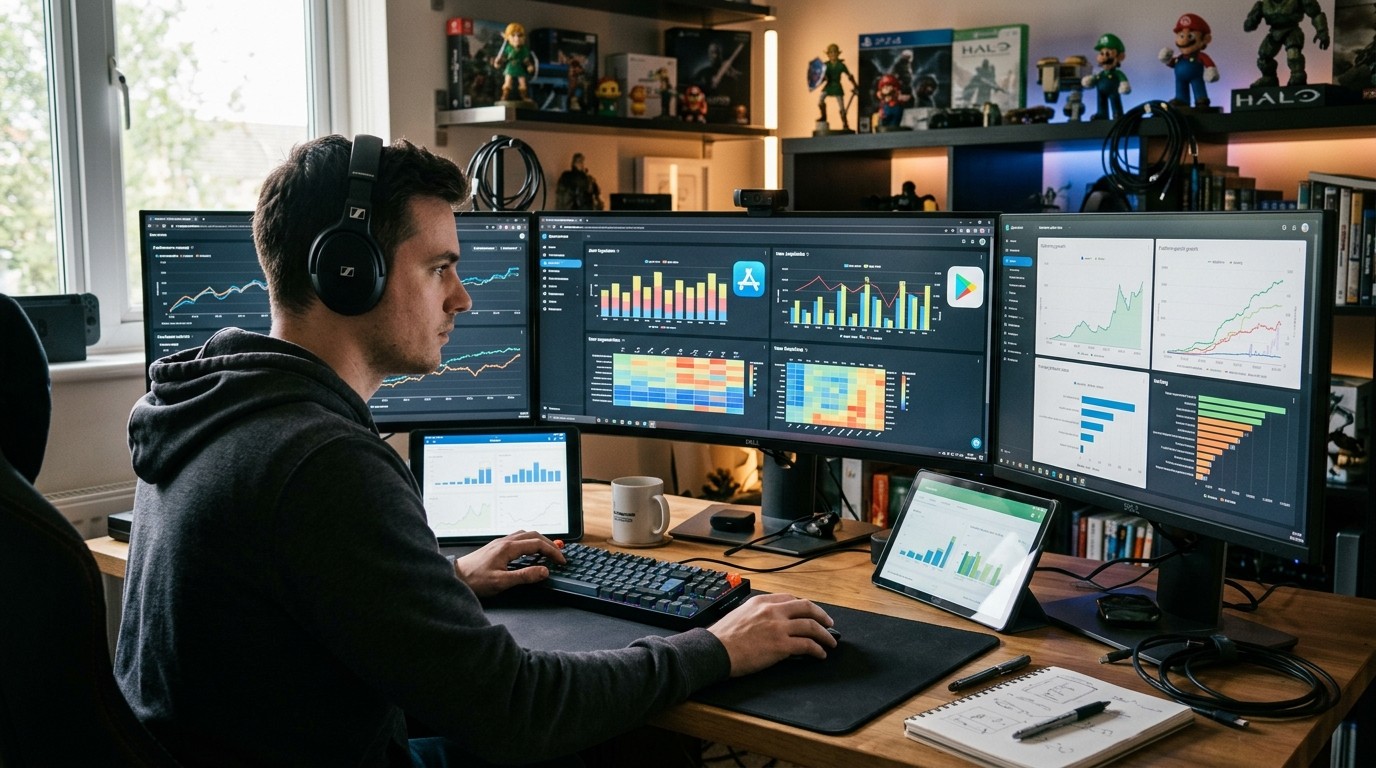
A Game Market Research App needs to respect that Apple and Google do not expose the exact same surfaces. Apple says App Store Connect Analytics helps measure how people discover and interact with apps and games, and its search-performance guidance specifically calls out impressions, conversion rate, and downloads. That means Apple-side research is often strongest when it is tied to discoverability and product-page behavior.
A Game Market Research App on the Android side should understand the Play Console’s emphasis on comparison and benchmarking. Google Play Console statistics let developers compare performance to similar apps and analyze trends in detail with custom dimensions. That makes Play data especially helpful for teams that want context instead of isolated numbers, because it shows how a game is performing relative to peers.
A Game Market Research App becomes even more practical when it treats Android Market vs App Store as a platform-comparison problem rather than a branding problem. On Apple’s side, the store analytics are tightly tied to impressions, product page views, conversion, and search behavior. On Google Play, the statistics view leans heavily into comparable metrics, custom dimensions, and monthly reporting. The two stores tell similar stories, but they emphasize different lenses.
A Game Market Research App should also consider policy and privacy surfaces because they affect user trust and market readiness. Google Play’s Data safety section exists to help people understand what data an app collects or shares, and that affects how researchers evaluate the competitiveness and trust profile of a listing. In a market where users compare alternatives quickly, transparency can influence installs as much as a headline feature.
The core feature set that matters most
A Game Market Research App should include keyword intelligence because discoverability drives installs. Sensor Tower says its App Performance Insights support keyword rankings and app visibility analysis, which is exactly the kind of feature that helps a team understand where a game appears in store search and how hard it may be to win attention. Keyword visibility is one of the most direct ways to compare market opportunities.
A Game Market Research App should also offer competitive benchmarking. Google Play Console lets developers compare their performance to similar apps, and Sensor Tower describes competitive intelligence depth and app performance benchmarking across regions as a major strength of its platform. Benchmarking matters because a raw number has little meaning unless you know whether the category is growing faster, slower, or roughly in line with peers.
A Game Market Research App becomes more actionable when it can segment by market, region, and time. Sensor Tower’s platform materials describe filtering by time, country, device, and other fields so teams can view specific cohorts of apps and trends. That kind of slicing is important because a game that looks average globally may be strong in one region and weak in another, which changes how teams budget and localize.
A Game Market Research App should also support monitoring and alerts. Sensor Tower describes app performance insights that include active users, sessions, and related signals, while Apple and Google both provide analytics environments that help teams track performance over time. The point is not to check numbers once; it is to build a habit of watching for trend changes before they become bigger business problems.
Reviews, ratings, and sentiment
A Game Market Research App becomes more useful when it can turn review text into product insight. Reviews often reveal whether players are frustrated by difficulty spikes, ads, onboarding, bugs, or payment flow. Sensor Tower includes ratings and reviews in its performance view, which shows that sentiment is not just a support problem; it is a market signal that can influence conversion and retention.
A Game Market Research App should help teams separate isolated complaints from repeated patterns. One angry review may not mean much, but recurring comments about the same issue can point to a real problem in the game experience or the store presentation. That is why reading review trends is often more helpful than only checking the average star score.
A Game Market Research App should connect reviews with timing. When a new build or store update goes live, the review stream often changes quickly. If negative sentiment spikes after a release, the team can investigate faster and decide whether the issue is content, performance, monetization, or a simple bug introduced in the update.
A Game Market Research App also benefits from understanding international differences in feedback. Sensor Tower’s materials mention internationalization scores and global filtering, which matters because the same game can be praised in one region and criticized in another for language, pacing, or monetization style. Research is stronger when it can show those regional contrasts instead of flattening them into one average.
Revenue, downloads, and retention logic
A Game Market Research App should always keep revenue and downloads together. A large download count does not automatically mean a healthy business, and a smaller install base can still be highly valuable if monetization and retention are strong. Sensor Tower explicitly ties app intelligence to revenue, downloads, and active usage, which helps teams avoid making decisions from vanity metrics alone.
A Game Market Research App should also help teams think in funnels. Apple’s App Store metrics move from impressions to product page views to conversion rate, while Google Play Console statistics add comparison and custom dimensions. Together, those systems show that acquisition is not one number; it is a sequence, and every step in that sequence can affect the next one.
A Game Market Research App becomes much more strategic when it helps explain retention instead of only acquisition. If a game brings users in but loses them quickly, the team needs to know whether the issue is gameplay pacing, tutorial friction, offer design, or technical performance. Sensor Tower’s focus on sessions and time spent gives at least part of that picture.
A Game Market Research App should also support decisions about price and product mix. When teams understand how frequently users return and how strongly players respond to different monetization styles, they can refine offers without blindly increasing pressure. Market research is most valuable when it moves a team away from assumption and toward evidence.
Launch timing and opportunity spotting
A Game Market Research App can help a team decide when a launch window is crowded and when it is comparatively open. If a category is saturated, a small team may need stronger differentiation or a more careful soft launch. Sensor Tower’s market intelligence materials emphasize seeing how apps perform across regions and over time, which is exactly what teams need when timing matters.
A Game Market Research App can also help identify soft-launch learning. Sensor Tower says its filtering and cohort tools allow teams to look at top and trending apps and narrow the field in useful ways. That is important because early signals often reveal whether a game is building momentum or stalling before the full launch budget is committed.
A Game Market Research App should make it easier to compare before-and-after snapshots. The best decisions often come from noticing what changed after a feature update, store-page refresh, or ad campaign adjustment. Apple’s App Analytics and Google’s Play Console statistics both support ongoing analysis, which means launch timing should be treated as a living process rather than a one-time event.
A Game Market Research App also helps teams notice opportunity in niche markets. A title can be modest in one large market and unusually strong in a smaller one. That difference might suggest localization, a different acquisition channel, or a separate community strategy. Research is most useful when it helps a team spot where attention is already forming.
Using insights in product and marketing work

A Game Market Research App is most valuable when its findings are turned into action. If users are bouncing from the store page, the creative needs a better hook. If keyword visibility is weak, metadata needs attention. If reviews are full of onboarding complaints, the product team needs to examine the first-session path. The insight matters only if it changes the next decision.
A Game Market Research App should help marketing teams decide whether to refine positioning or shift audience targeting. Sensor Tower’s advertising and app intelligence materials show how app performance, advertising, and audience insights can live in one platform, which is useful because store performance and marketing performance are tightly linked. A good tool reduces the gap between what is being spent and what is actually happening.
A Game Market Research App can also guide creative testing. If a store page or ad asset is attracting clicks but not installs, the promise may not match the product-page reality. If installs rise after a copy change, the new message may be better aligned to the audience. App Store and Play Console analytics help verify that these changes are actually moving behavior rather than simply looking good in a meeting.
A Game Market Research App should support cross-functional conversations. Product, growth, UA, and publishing teams often look at the same game from different angles, and market research helps them share a common factual base. When everyone is looking at the same signals, it becomes easier to agree on priorities and harder to rely on personal preference alone.
Building a smarter workflow
A Game Market Research App works best when it is part of a repeatable routine. A team should review store analytics, compare the category, scan review trends, and then write down one or two concrete actions. That rhythm matters because the value of research compounds when it is used consistently rather than only during a launch crisis.
A Game Market Research App should also fit into the team’s reporting system. If the app can export or present data cleanly, leaders can track patterns without forcing everyone to open multiple dashboards. Google Play Console says developers can download monthly reports, which shows how regular reporting is built into the platform approach itself.
A Game Market Research App should keep the analysis simple enough to act on. Too many metrics can create the illusion of rigor while making the final decision less clear. The best workflow usually focuses on a few core questions: what is working, what is slipping, and what should change next? That keeps the research grounded in use, not just in data volume.
A Game Market Research App should also align with privacy and compliance thinking. Google Play’s Data safety section is one example of how app ecosystems increasingly expect clarity about user data collection and sharing. A team that understands those expectations can evaluate competitors more intelligently and avoid overlooking trust-related signals that affect installs and reputation.
Publishing and site-maintenance considerations
A Game Market Research App team often needs a content hub or internal knowledge base to share findings. If that hub runs on WordPress, it is wise to Update GPL Themes carefully because WordPress theme guidance requires GPL compatibility and recommends using GPLv2 or later. WordPress also states that the platform itself is GPLv2 or later, which is why theme licensing should be treated as part of site maintenance rather than a side note.
A Game Market Research App project can also benefit from thinking clearly about Premium Vs Free Themes. WordPress.org’s commercial GPL themes page explains that some providers offer paid support or membership services around GPL themes, while the theme directory itself includes thousands of free themes. The right choice depends less on the label and more on support, maintenance, and how stable the publishing environment needs to be.
A Game Market Research App hub should be easy to update, because research reports age quickly. If the site is hard to maintain, the team stops publishing insights, and useful data gets buried. WordPress’s open, theme-based publishing model is designed for flexibility, which makes it a natural fit for a site that needs regular content updates and clean presentation.
A Game Market Research App reporting page should also make it easy to find the newest observations, not just the most polished design. The goal of the site is to communicate what the data says now. That means structure, readability, and steady maintenance matter more than decorative complexity. Clean publishing systems help the research stay visible and useful to the people who need it.
Common mistakes to avoid
A Game Market Research App should not be treated as a magic answer machine. A dashboard can show useful signals, but a team still has to interpret them with context. If one metric rises while another falls, the result may be more complicated than it first appears. Good research is not just collecting numbers; it is deciding which numbers deserve the most attention.
A Game Market Research App also becomes less useful when a team overreacts to small samples. A handful of reviews or a single day of ranking movement can be misleading, especially in fast-moving categories. Apple and Google both provide ongoing analytics views for a reason: trends are more useful than isolated spikes. The safer move is to compare patterns over time.
A Game Market Research App should not ignore store-page quality. A strong game can still underperform if the icon, screenshots, description, or preview do not clearly communicate the value. App Store search performance metrics and Play Console statistics both show how discovery and comparison shape outcomes, which means presentation is part of the market data, not separate from it.
A Game Market Research App should also avoid separating monetization from user experience. High revenue can hide a weak player journey for a while, but long-term business health usually depends on both. That is why the strongest research view connects store behavior, revenue, and engagement instead of praising a single metric in isolation.
Choosing the right tool

A Game Market Research App is easiest to choose when you decide what problem it must solve first. Some teams need ASO visibility, others need revenue estimates, others need competitor benchmarking, and others need review analysis. Sensor Tower presents one version of the market intelligence model, while Apple and Google provide first-party analytics inside their own ecosystems. The right tool is the one that fills the gaps your current workflow cannot cover.
A Game Market Research App should be tested against real use cases, not only feature lists. If you need keyword rankings, you should see how the app handles them. If you need regional comparison, you should check how it slices the data. If you need store-performance clarity, you should look for metrics like impressions, page views, conversion rate, and benchmarks against similar apps.
A Game Market Research App is strongest when it matches team size and maturity. Smaller teams often need simpler workflows and clearer dashboards, while larger teams may want deeper filtering, exports, and cross-market comparisons. A good tool reduces decision friction instead of creating another layer of process, which is the real test of whether it will be used consistently.
A Game Market Research App should ultimately help the team answer a practical question: what should we do next? When the tool leads to clearer priorities, stronger launches, and more disciplined experimentation, it is doing its job. If it only produces reports, it is still information, but it is not yet strategy.
Conclusion
A Game Market Research App is valuable because it turns store behavior, competitive movement, and player feedback into decisions that are easier to trust. Apple’s App Store Connect analytics, Google Play Console statistics, and third-party market-intelligence platforms all show that modern app research is no longer just about downloads; it is about discovery, conversion, engagement, benchmarking, and sentiment. When teams read those signals together, they can decide more confidently about launch timing, positioning, monetization, and product changes. The best systems do not replace judgment; they sharpen it. That is what makes a good research app useful long after the first report is generated.
Frequently Asked Questions (FAQ)
1. What does a Game Market Research App do?
A Game Market Research App helps teams study downloads, revenue, ratings, reviews, keywords, and competitor performance so they can make better product and marketing decisions.
2. Why is App Market Research important for games?
App Market Research matters because game categories change quickly, and teams need evidence about discovery, conversion, retention, and competition before they spend heavily on launch or ads.
3. What metrics matter most in store analysis?
Impressions, product page views, conversion rate, downloads, ratings, reviews, sessions, and time spent are among the most useful signals because they show both interest and engagement.
4. How does the iPhone side differ from Android?
The iPhone side leans heavily on App Store Connect analytics and search-performance metrics, while Android’s Play Console emphasizes comparative statistics, custom dimensions, and benchmark views.
5. What does Android Market vs App Store mean in practice?
Android Market vs App Store usually means comparing Google Play and Apple’s App Store as different ecosystems with different analytics surfaces, reporting styles, and data-visibility strengths.
6. Should reviews be treated as research data?
Yes. Reviews and ratings often reveal friction in onboarding, bugs, monetization, or difficulty balance, which makes them a valuable part of market insight rather than just support feedback.
7. Do benchmark tools really help?
They do, because seeing how an app compares to similar apps gives numbers context, and context is what turns a metric into a decision.
8. Why mention Update GPL Themes in a research guide?
If the team publishes reports or maintains a WordPress knowledge hub, Update GPL Themes carefully because WordPress requires GPL-compatible themes and recommends GPLv2 or later.
9. Are Premium Vs Free Themes relevant?
Yes, when the research team manages a WordPress site, because Premium Vs Free Themes usually comes down to support, maintenance, and workflow needs rather than basic license freedom.
10. What is the best habit for using these tools well?
Use the numbers regularly, compare trends instead of snapshots, and turn every insight into one concrete action for product, marketing, or publishing.