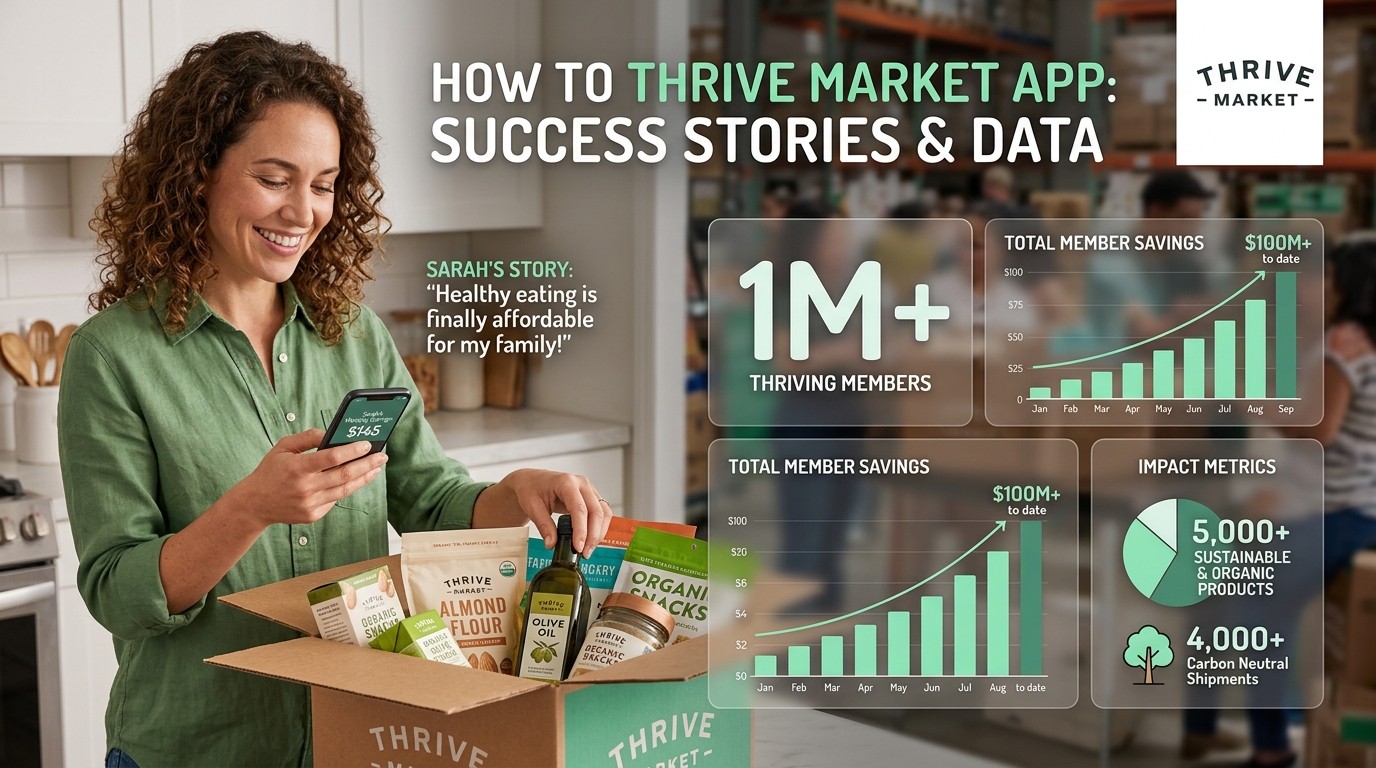
Thrive Market shows how a membership grocery platform turns convenience, savings, and repeat ordering into measurable mobile growth while keeping the shopping experience simple, repeatable, and easy to trust.
Thrive Market App is a useful example of how a membership grocery platform can turn convenience into repeat buying. Thrive Market says members get access to organic and non-GMO groceries, personal care, household essentials, and more, and its help center says the app is available on both Apple App Store and Google Play. That matters because the Thrive Market App is more than a storefront; it is the place where savings, reordering, and member-only perks come together in one routine. That practical simplicity is part of why the product feels closer to a habit than a campaign.
The value proposition behind the Thrive Market App is easy to understand: make healthy shopping less expensive and less effortful. Thrive Market says members can save up to 30% on organic and sustainable products, and its landing pages emphasize fast carbon-neutral shipping, 90+ filters, and access to products curated for diet and lifestyle needs. That combination helps the Thrive Market App feel less like a one-time purchase tool and more like a long-term shopping habit. This combination of savings and convenience is what turns a grocery app into a repeat-use subscription habit.
One reason the Thrive Market App works is that it lowers search friction. Instead of forcing people to browse a huge grocery catalog, Thrive Market organizes shopping around categories such as pantry, frozen, household, vitamins, and beauty. The Thrive Market App then makes it easier to discover what fits a specific diet or household routine, which reduces the mental load that often slows online grocery decisions. That is also why a focused catalog can outperform a larger but less organized shopping experience.
The Thrive Market App also benefits from direct platform access. Thrive Market’s help center explains that users can install the app from the Apple App Store or Google Play and sign in with their membership to start shopping. That sounds simple, but simplicity is a major success factor in subscription commerce. The Thrive Market App succeeds when the member can move from curiosity to purchase without extra steps that create doubt or delay. This direct path from download to shopping is one of the quiet reasons the service keeps recurring use high.
Data that stands out

Data inside the Thrive Market App story shows how membership and value can scale together. Thrive Market’s 2024 mission impact report says the company reached more than 1.5 million members after ten years, and the same report says paid annual memberships sponsor free one-year memberships for qualifying groups. Those numbers matter because the Thrive Market App is tied to a mission-driven model, not just a standard grocery app. Those numbers are important because they show that mission and scale can grow together instead of competing.
The Thrive Market App also benefits from weekly rewards and gift mechanics. Thrive Market’s help articles say eligible members can receive alerts for free gifts and redeem them through the homepage or app, while product and member pages mention free full-size gifts and deals on favorite brands every week. That kind of reward loop can make the Thrive Market App feel active even when the user is not placing a large order. Reward loops like this work best when they feel like a bonus, not a distraction from the main shopping task.
Another reason the Thrive Market App has staying power is the breadth of categories. Thrive Market’s own pages describe access to food, home, beauty, vitamins, and The Teen Shop, while the product catalog highlights exclusive member brands and recurring savings. The Thrive Market App becomes valuable when the member can shop the same place for pantry staples, cleaning supplies, and supplements instead of switching platforms every week. That breadth matters because household buying is rarely one-dimensional, and people like fewer checkouts.
The app also has measurable consumer credibility. Google Play shows the Thrive Market app with a 4.8-star rating, which suggests that many Android users find the experience useful enough to recommend. Ratings are only one signal, but they matter because the Thrive Market App is designed for repeat use. An app that frustrates users will not keep them coming back for membership shopping. Ratings matter because they tell new users whether the app is frictionless enough to trust.
The Thrive Market App is especially effective because the company clearly describes the member savings model. Thrive Market says members can save up to 30% on organic groceries and household essentials, and some pages also describe access to 650+ exclusive brands and daily deals in local market pages. That makes the Thrive Market App feel closer to a subscription value engine than a one-off discount tool. A clear savings promise lowers hesitation and helps the customer justify the first order quickly.
A strong Thrive Market App also helps shoppers manage recurring behavior. Thrive Market’s “How it Works” pages emphasize subscribing to favorite items, skipping or pausing shipments, and placing one-time orders when needed. That flexibility matters because subscription fatigue is real. The Thrive Market App performs better when it gives the customer control instead of forcing rigid ordering patterns. That flexibility is what makes the platform feel respectful of real life rather than rigidly subscription-only.
A good success story for the Thrive Market App comes from Thrive Market’s own blog, where one member was highlighted as having saved $6,000 by ordering pantry staples, meat, seafood, household products, and wine through the service. Success stories like that are powerful because they translate abstract savings into an actual household outcome. The Thrive Market App becomes easier to trust when the numbers feel personal. Personal success stories are stronger when they sound specific, measurable, and tied to ordinary family spending.
The Thrive Market App also sits inside a mission-driven customer story. Thrive Market’s reporting says the company donated $13.4 million in healthy groceries by the end of 2023, and the brand says every paid annual membership sponsors a free one-year membership for a teacher, nurse, first responder, student, veteran, or family in financial need. That makes the Thrive Market App feel tied to access, not just savings. Mission data helps the app feel bigger than commerce because people like supporting a brand with visible purpose.
Why the data matters
The strongest numbers in the Thrive story are useful because they connect product behavior to business behavior. A service that reports more than 1.5 million members, healthy-groceries donations, product breadth, and clear savings claims is showing more than traffic. It is showing repeatable usage and a reason for customers to return.
Success stories work for the same reason. A member story about saving thousands of dollars is memorable because it translates abstract value into household reality. That is what makes evidence persuasive. People trust proof that sounds specific, practical, and close to their own lives.
Lessons for digital growth

The Thrive Market App is a useful model for a Local Market App Strategy because it shows how a focused audience can be served with repeated value rather than broad, unfocused features. A local or niche market app works better when it knows what its users need, how they browse, and what keeps them returning. The Thrive Market App succeeds by making the buying habit easier, not more complicated. A focused app strategy usually wins when it serves a real community better than a giant undifferentiated marketplace.
For teams comparing a Best App Market Android Alternative, the Thrive Market App offers an interesting lesson: a niche retail app can win by being organized, curated, and repetitive in a good way. It does not need to imitate every giant marketplace. Instead, the Thrive Market App shows how a narrower product mix, clear membership value, and predictable reordering can create loyalty and reduce search fatigue. That lesson is especially useful for mobile teams trying to win through relevance instead of scale alone.
The Thrive Market App also has a lesson for businesses that think in Industrial Automation Software terms. In automation, the goal is not just speed; it is repeatability, fewer errors, and cleaner handoffs. The Thrive Market App works in a similar way by turning shopping into a repeatable system with filters, subscriptions, and easy fulfillment rather than a series of one-off decisions. The automation comparison is useful because both systems reward repeatability and low-error workflows.
The same logic applies if you think about Laboratory Automation Software. In a lab, the workflow matters because a clean process reduces mistakes and keeps results reliable. The Thrive Market App borrows that kind of thinking for commerce: reduce clutter, standardize discovery, and make the important actions easy to repeat so the customer can trust the process over time. The lab analogy works because trust often comes from controlled processes that are easy to understand and repeat.
The Thrive Market App also helps marketers think about how content and promotions are managed on a website. A clean content layout, a clear call to action, and a controlled promotional rhythm all matter when the goal is to grow a list or drive repeat visits. If the site also uses an AdSense Management Plugin, the team can keep ads organized without letting them overwhelm the shopping or content experience, which helps the app feel more polished as a brand touchpoint. A tidy promotional layer can improve trust when the shopping experience stays calm and readable.
In affiliate publishing, the Thrive Market App is a reminder that a useful product experience and a well-structured content experience are closely related. A site may use an Affiliate Link Cloaker to organize tracking links and keep URLs readable, but the deeper lesson is about trust. The app shows that users respond to clear categories, transparent value, and simple decision paths. Readable links and organized tracking help the reader stay focused on the content instead of the mechanics.
The Thrive Market App also gives a useful example of how success stories can be told without hype. Thrive Market publishes member stories, mission updates, and savings claims directly on its own site, so the evidence is close to the product. When a brand can connect the product, the data, and the story, the Thrive Market App becomes easier to explain and easier to recommend. That kind of proof is more persuasive than generic marketing because it connects the app to actual behavior.
The Thrive Market App works best when the onboarding and repeat-order experience feel safe. Thrive Market says it offers carbon-neutral shipping, shop-by-diet filters, and a wide catalog of organic and sustainable products. That combination reduces the fear of making the wrong purchase. A customer who feels less risk is more likely to place the first order and later return through the Thrive Market App. Retention grows when the welcome path, the reorder flow, and the savings promise all feel aligned.
What marketers can learn

The Thrive Market App is also stronger when it supports family and household planning. Thrive Market’s product pages and help pages show food, supplements, household items, and personal care all in one ecosystem, which means the member can handle several shopping needs in one app. That convenience is a major reason the Thrive Market App can keep growing without constantly chasing new audiences. A simple comparison checklist helps the team decide whether the app is solving a real user problem.
A practical lesson from the Thrive Market App is that app growth often comes from repeated utility rather than novelty. A feature like one-tap reorder may not seem exciting on paper, but it is exactly the kind of behavior that keeps members active. The Thrive Market App wins when it removes small annoyances that would otherwise push shoppers back to a generic grocery run. That is why the business lesson is really about reducing friction more than adding features.
The Thrive Market App also benefits from visible trust signals such as brand pages, help-center support, and clear membership language. Thrive Market’s official pages explain how to install the app, how to redeem gifts, how free memberships work, and how members can save money. That clarity reduces hesitation. When the user understands the rules, the Thrive Market App feels easier to commit to. Strong trust signals make the first purchase feel safer and the second purchase feel easier.
The Thrive Market App can be summarized as a membership system that packages healthy shopping, savings, and convenience into one repeatable routine. The company’s own data on member growth, donations, savings claims, and product breadth all point in the same direction: when the offer is clear and the execution is smooth, people keep using it. That is the broader business lesson hidden inside the Thrive Market App. Repeat utility is what turns a useful app into a durable household habit.
Quick comparison table
| Signal | What it shows | Why it matters |
|---|---|---|
| Member growth | More than 1.5 million members in Thrive’s 2024 report | Shows scale and repeat demand |
| Savings claim | Members can save up to 30% on selected products | Makes the value proposition easy to understand |
| Product breadth | More than 650 products across Thrive’s brands | Helps shoppers cover more household needs |
| Member support | Free one-year memberships for qualifying groups | Ties growth to mission and access |
Conclusion
Thrive Market blends membership value, app convenience, and mission-driven data into a growth model that feels practical instead of flashy. The clearest lesson is that the best digital retail app is the one that removes friction, builds trust, and makes the next order feel easy. When the shopping flow is clear, the savings promise is visible, and the mission feels genuine, the app becomes more than a place to buy groceries; it becomes a routine people return to. That is why the Thrive case is useful for marketers, product teams, and founders who want repeat behavior instead of one-time clicks.
Frequently Asked Questions (FAQ)
1. What exactly is the Thrive Market app?
Thrive Market’s app is the mobile version of its membership grocery service, letting members shop organic and non-GMO groceries, household essentials, personal care, and more from Apple or Android devices. The basic idea is to turn a recurring shopping need into a repeatable digital habit. It also keeps the catalog, rewards, and reordering flow in one place, which lowers friction.
2. Why do members use it instead of a normal grocery app?
Members use it because the app combines savings, convenience, and curation in a way that fits real household shopping. Thrive says members can save up to 30% on selected products, and its pages emphasize carbon-neutral shipping, 90+ filters, and member-only perks. That mix makes the app easier to justify than a generic store app that solves only part of the problem.
3. What data makes Thrive Market interesting as a case study?
The most useful data points are the ones that show scale, savings, and mission together. Thrive’s 2024 report says the community reached more than 1.5 million members after ten years, and the brand says it donated $13.4 million in healthy groceries by the end of 2023. Those figures show the app is connected to both repeat demand and social impact.
4. How does the app support repeat shopping behavior?
The app supports repeat shopping by reducing decisions. Shoppers can save lists, subscribe to favorites, skip or pause recurring shipments, and place one-time orders when life changes. That matters because the best subscription products do not lock people in; they make it easy to stay because the experience remains useful and flexible over time.
5. What kind of success stories does Thrive share?
Thrive’s own blog and impact materials provide the clearest success stories. One member story highlighted $6,000 in savings across pantry staples, meats, seafood, household products, and wine. That story works because it turns vague value into a concrete household result. Readers can imagine how the app might help their own budgets, which is more persuasive than a generic pitch.
6. How does it connect to broader digital growth lessons?
Marketers can learn that a good app is a system, not just a download destination. The design, onboarding, savings logic, reminder flow, and content all work together. When those pieces align, the app becomes part of a larger growth engine. That lesson applies to many digital products, not only groceries, because clarity and repeatability usually beat novelty.
7. Is the app mainly about savings or convenience?
The app is both about savings and convenience, but the two are connected. Savings gets people interested, while convenience keeps them coming back. Thrive Market’s pages emphasize up to 30% savings, free gifts, and fast shipping, which makes the economic value easy to see. The convenience layer matters because repeat ordering becomes much easier once trust is built.
8. Why do mission and donations matter in the brand story?
Mission matters because it gives the brand a reason to exist beyond pure commerce. Thrive says paid annual memberships sponsor free one-year memberships for qualifying groups such as teachers, nurses, first responders, students, veterans, and families in need. That kind of mission language builds emotional credibility and makes the app feel like part of a bigger good.
9. What should marketers learn from the platform design?
Designers and product teams can learn that clear structure matters more than visual complexity. Thrive’s catalog organization, filter system, and membership messaging show that users respond well to a clean path. If people can understand what to buy, why it is relevant, and how to reorder it, the app becomes easier to trust and easier to use again.
10. How can a site owner use this example in planning?
A site owner can use the example by thinking in terms of user friction. If one app reduces friction by making shopping clearer, a website should do the same through better layout, clearer calls to action, and better follow-up. The lesson is about making the next step obvious.