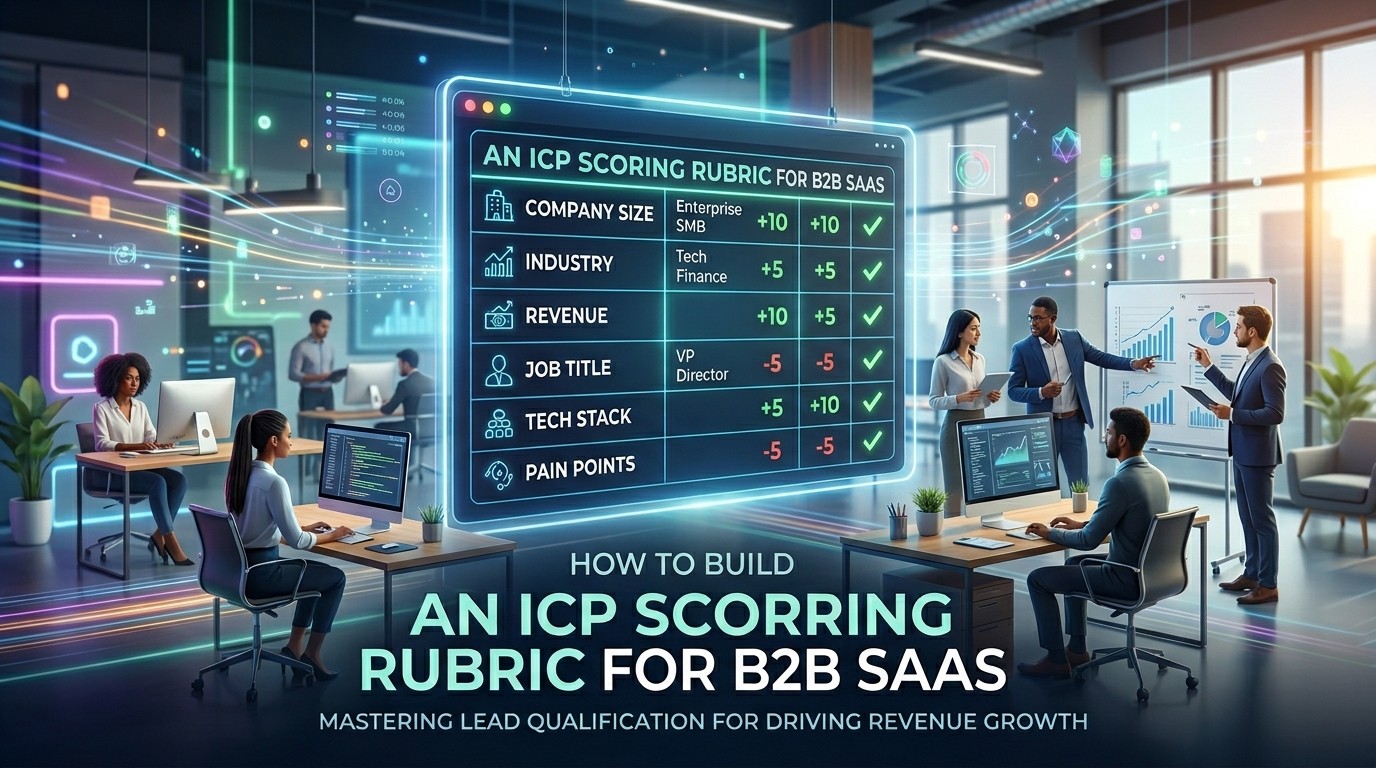
ICP Scoring Rubric For B2B SaaS helps teams rank accounts by fit, intent, and value so marketing and sales can focus on the best opportunities first. ICP Scoring Rubric For B2B SaaS reduces waste.
ICP Scoring Rubric For B2B SaaS is one of the most practical tools a growth team can build when it wants better lead quality and more predictable pipeline. B2B SaaS companies often collect plenty of contacts, but not every contact deserves the same level of attention. Some leads match the product perfectly. Some are curious but unqualified. Some will never buy. ICP Scoring Rubric For B2B SaaS helps the team separate those groups in a structured way so that sales and marketing can spend time where it matters most.
The reason this matters is human as much as it is operational. People respond better when the message feels relevant to their size, role, industry, and pain point. ICP Scoring Rubric For B2B SaaS creates a shared language for deciding which accounts fit that pattern and which ones do not. It reduces guesswork and makes the funnel calmer. When the team knows what a good account looks like, it can stop chasing every lead and start prioritizing the right ones. That is how better qualification leads to better conversion.
This guide explains how to build the rubric step by step, how to decide which factors matter most, how to score objectively, and how to keep the system useful as the company grows. It also shows how the rubric supports SaaS Marketing Mastery, how agencies can use it, and how it connects to broader business thinking. ICP Scoring Rubric For B2B SaaS is not just a spreadsheet. It is a decision framework.
Why an ICP rubric matters
ICP Scoring Rubric For B2B SaaS matters because B2B pipelines often become noisy very quickly. A team can get many leads, but still struggle to find accounts that truly fit the product. Without a rubric, sales may spend too much time on weak opportunities and too little time on strong ones. ICP Scoring Rubric For B2B SaaS solves that problem by giving every lead a consistent evaluation method.
The psychological advantage is important too. People trust systems more when the rules are clear. ICP Scoring Rubric For B2B SaaS creates that clarity by showing why one lead gets priority over another. That helps internal teams feel more confident about handoffs and follow-up. It also makes the company look more disciplined from the outside because prospects receive more relevant communication.
Another reason the rubric matters is that it helps teams learn. When the same scoring model is used over time, leaders can see which traits correlate with strong deals and which ones do not. ICP Scoring Rubric For B2B SaaS therefore becomes a learning tool, not just a ranking tool. That learning can improve targeting, messaging, and sales performance all at once.
What the rubric should measure

ICP Scoring Rubric For B2B SaaS should measure both fit and intent. Fit tells you whether the account matches the company’s ideal profile. Intent tells you whether the account is likely to engage soon. If a lead fits perfectly but shows no buying behavior, it may still need nurturing. If a lead shows strong intent but poor fit, it may not be a good long-term opportunity. ICP Scoring Rubric For B2B SaaS works best when both sides are included.
The main categories usually include firmographics, role, use case, pain level, buying stage, and engagement behavior. A team can score these areas separately and then combine them into one final number or tier. ICP Scoring Rubric For B2B SaaS should be simple enough to use daily, but detailed enough to distinguish strong from weak accounts. That balance is what makes the rubric practical.
It also helps to define what the scoring is for. Is it for routing? Prioritization? Segmentation? Sales readiness? ICP Scoring Rubric For B2B SaaS becomes much easier to design when the purpose is clear from the start. A rubric built for prioritization may look different from one built for lifecycle segmentation. The goal should guide the structure.
Core scoring dimensions at a glance
| Dimension | What it shows |
|---|---|
| Firmographics | Company size, industry, location, revenue |
| Role fit | Whether the contact can influence the decision |
| Pain fit | Whether the problem is strong enough |
| Intent signals | Whether the lead is actively engaged |
| Product alignment | Whether the use case matches the product |
| Sales readiness | Whether the account is worth immediate follow-up |
ICP Scoring Rubric For B2B SaaS becomes much more useful when these dimensions are visible and separate. Combining everything into one vague score often hides the real reason a lead is strong or weak. The best rubrics allow teams to see the pattern behind the number.
Start with the ideal customer profile
ICP Scoring Rubric For B2B SaaS must begin with a real ideal customer profile. The profile is not a guess and not a wish list. It should be based on current customers, deal history, retention trends, and product value. If the company already knows which accounts stay longer, buy more, and support the product well, that data should shape the rubric.
A useful profile usually includes company size, industry, geography, tech stack, budget range, growth stage, and pain point. ICP Scoring Rubric For B2B SaaS becomes sharper when those traits are grounded in actual outcomes rather than assumptions. A company that sells to high-growth mid-market SaaS firms should not score the same way as a company that sells to small local service businesses. The rubric should reflect reality.
It also helps to separate must-have traits from nice-to-have traits. Some criteria should be mandatory because they define true fit. Other criteria should simply improve the score. ICP Scoring Rubric For B2B SaaS becomes easier to manage when the team knows which traits are essential and which ones are just helpful.
Fit scores versus intent scores
ICP Scoring Rubric For B2B SaaS works best when fit scores and intent scores are distinct. Fit is about who the account is. Intent is about what the account is doing. A company may be a perfect fit but still early in the buying journey. Another may be showing strong activity but still be outside the target market. Keeping the two categories separate helps the team make smarter decisions.
A fit score may include firmographics, role relevance, and product alignment. An intent score may include email opens, demo requests, pricing page visits, content downloads, webinar attendance, or repeat visits. ICP Scoring Rubric For B2B SaaS should combine them only after each has been evaluated on its own. That allows the team to distinguish between a good account and a ready account.
This separation also helps with routing. A high-fit, low-intent lead may need nurture. A low-fit, high-intent lead may need disqualification or lighter handling. ICP Scoring Rubric For B2B SaaS becomes much more strategic when the team sees the difference instead of flattening all signals into one bucket.
Weighting the criteria
ICP Scoring Rubric For B2B SaaS needs weights because not every factor has the same importance. A company size match may matter more than a content download. A pricing page visit may matter more than a single social interaction. Weights help the rubric reflect real buying behavior instead of treating every action equally.
The best way to assign weights is to study closed-won and closed-lost deals. Look for patterns. Which traits show up repeatedly in strong accounts? Which behaviors appear before the opportunity gets serious? ICP Scoring Rubric For B2B SaaS becomes stronger when the weighting is based on evidence rather than intuition alone. The more the rubric reflects the past, the more useful it becomes for the future.
That said, the rubric should still be simple enough for the team to understand. Too many weights can make the system hard to explain and hard to use. ICP Scoring Rubric For B2B SaaS should help people make faster decisions, not create a new layer of confusion.
A sample scoring model
ICP Scoring Rubric For B2B SaaS can be built with a simple 100-point scale. For example, firmographic fit may be worth 30 points, role fit 15, pain fit 20, intent behavior 20, and product alignment 15. A lead with 80 or above may be considered high priority. A lead between 50 and 79 may need nurture. A lead below 50 may be low priority or disqualified depending on the business model.
This is only one example. ICP Scoring Rubric For B2B SaaS should always reflect the company’s actual sales motion. A high-ticket enterprise product may need a heavier weight on role fit and buying authority. A simpler self-serve product may care more about product usage and digital behavior. The model should fit the motion, not the other way around.
The best scoring systems are also easy to audit. If a rep asks why a lead scored high, the answer should be clear. ICP Scoring Rubric For B2B SaaS works better when the logic is transparent and repeatable.
The role of marketing and sales alignment

ICP Scoring Rubric For B2B SaaS is most effective when marketing and sales agree on what good looks like. If marketing thinks one type of account is ideal but sales closes another, the rubric will drift. That is why the process should involve both teams from the beginning. ICP Scoring Rubric For B2B SaaS becomes a shared asset when both sides help define it.
Alignment matters because it improves trust. When sales trusts the score, follow-up gets faster and more focused. When marketing understands the score, campaigns become more targeted. ICP Scoring Rubric For B2B SaaS connects the funnel so teams are not judging leads by different standards. That creates less conflict and more efficiency.
This is also where SaaS Marketing Mastery comes into play. Better scoring improves targeting, better targeting improves messaging, and better messaging improves pipeline quality. ICP Scoring Rubric For B2B SaaS supports that loop by giving the team a practical way to focus on accounts that are more likely to convert.
Data sources that improve the rubric
ICP Scoring Rubric For B2B SaaS should use multiple data sources when possible. CRM fields, website behavior, product usage, firmographic enrichment, email engagement, and lead source can all contribute useful signals. The more reliable the data, the more useful the score. But the rubric should never depend on data the company cannot collect consistently.
Sometimes the best improvements come from simple data cleanup. If company size is missing, role data is messy, or source attribution is weak, the rubric will become unreliable quickly. ICP Scoring Rubric For B2B SaaS depends on quality inputs. A clean database makes a good rubric work better than a fancy model built on poor information.
It is also smart to keep the signals meaningful. More data is not always better. ICP Scoring Rubric For B2B SaaS should focus on signals that actually predict sales quality. If a field does not help decisions, it should not carry much weight.
Using the rubric in the funnel
ICP Scoring Rubric For B2B SaaS should be used at several points in the funnel, not just once. It can help qualify inbound leads, prioritize outbound targets, segment nurture flows, and route leads to the right rep. That makes it a flexible tool for the whole growth system.
At the top of the funnel, the rubric can filter out weak accounts early. In the middle, it can help marketing personalize outreach. Near the bottom, it can help sales decide who needs attention now. ICP Scoring Rubric For B2B SaaS becomes much more valuable when it supports the entire journey instead of only one stage.
This approach also helps with resource management. Teams can spend more time on better accounts and less time on leads that do not fit. That efficiency matters because every hour spent on the wrong lead is an hour not spent on the right one.
Updating the rubric over time
ICP Scoring Rubric For B2B SaaS should not stay frozen forever. Markets change, products change, and buyer behavior changes. A rubric that worked last year may be too rigid or too loose today. That is why regular review is important. The team should compare the rubric against actual deal outcomes and adjust it when needed.
The best review rhythm is simple and regular. Look at the highest-scoring closed-won accounts. Look at the low-scoring accounts that still converted. Look at the high-scoring accounts that went nowhere. ICP Scoring Rubric For B2B SaaS improves when the team uses these examples to refine the criteria and weights.
This review process also keeps the rubric honest. If the score is no longer predicting strong outcomes, the company should not keep pretending it works. ICP Scoring Rubric For B2B SaaS should serve the business, not the other way around.
Common mistakes to avoid
ICP Scoring Rubric For B2B SaaS can fail if the team makes a few common mistakes. One is scoring too many weak signals and giving them too much weight. Another is building a rubric that is too complicated for daily use. A third is never revisiting the model after launch. ICP Scoring Rubric For B2B SaaS works best when it is useful, simple, and current.
Another mistake is confusing popularity with fit. A contact may engage with lots of content but still not match the ideal customer profile. ICP Scoring Rubric For B2B SaaS should not reward activity alone. It should reward activity plus real fit. That distinction keeps the team focused on quality.
A final mistake is treating the rubric as a replacement for judgment. ICP Scoring Rubric For B2B SaaS supports decisions, but it should not remove human thinking. Reps and marketers still need to use context and common sense.
How agencies can help
A strong external partner can speed up the process. The Best B2B SaaS Marketing Agency often helps with data review, scoring logic, segmentation strategy, and funnel alignment. That can save time and reduce trial-and-error when the internal team does not have a mature scoring system yet. ICP Scoring Rubric For B2B SaaS can be easier to build with outside perspective.
Agencies are especially helpful when the business has data but no structure. They can help turn scattered information into a practical framework. ICP Scoring Rubric For B2B SaaS benefits from that kind of experience because the scoring model becomes more grounded in real campaign and pipeline behavior. The right partner should not just suggest a formula. They should help the company understand why the formula works.
That is also why the rubric should remain easy for the internal team to own later. A good agency helps build something the company can manage long term, not something it needs outside help to understand forever.
Connecting the rubric to industrial and scientific markets

ICP Scoring Rubric For B2B SaaS can also learn from other industries where precision matters. Industrial Automation Software markets often depend on long buying cycles, technical fit, and clear operational value. That kind of market discipline is useful because it shows how important qualification is when the decision is complex.
The same idea applies to Laboratory Automation Software, where the buyer often cares about reliability, precision, and workflow fit. ICP Scoring Rubric For B2B SaaS can borrow from those examples by focusing on the signals that matter most to technical buyers. In both cases, the account must fit the use case before it is worth serious attention.
That cross-industry thinking helps the rubric become more robust. It reminds the team that not all intent is equal and not all interest is valuable. ICP Scoring Rubric For B2B SaaS is strongest when it respects that nuance.
A practical build process
The easiest way to create ICP Scoring Rubric For B2B SaaS is to start small. First, define the ideal customer profile using real data. Second, choose the few signals that matter most. Third, assign weights based on closed-won patterns. Fourth, test the rubric on recent leads and deals. Fifth, refine it after the team has used it for a while.
This process keeps the rubric from becoming theoretical. ICP Scoring Rubric For B2B SaaS should be built around evidence, not assumptions. It should also be practical enough that marketing, sales, and leadership can all understand it quickly. If the company cannot explain the rubric in a simple way, it may be too complicated to use well.
That simplicity is what makes it powerful. A good rubric can change how the team prioritizes accounts every day. It can improve pipeline quality, reduce wasted effort, and make the whole demand process more focused.
Conclusion
A strong qualification system helps B2B SaaS teams spend time on the right accounts and ignore the wrong ones. When fit, intent, and behavior are scored clearly, the team can prioritize smarter and move faster with more confidence. A practical rubric also strengthens marketing and sales alignment, which improves conversion quality over time. The goal is not to create a perfect model. The goal is to create a useful one that reflects real buying behavior and can be improved as the business learns. When the scoring process is simple, transparent, and grounded in outcomes, it becomes a durable part of the growth engine.
Frequently Asked Questions (FAQ)
1. What is an ICP Scoring Rubric For B2B SaaS?
It is a structured way to score leads or accounts based on how well they match the ideal customer profile and how ready they are to buy.
2. Why is it important?
It helps teams prioritize better accounts, reduce wasted effort, and improve lead quality.
3. What should it measure?
It should measure both fit and intent, using signals like firmographics, role, behavior, and product alignment.
4. How do I start building one?
Start with real customer data, define the ideal profile, and choose the strongest predictive signals.
5. Should sales and marketing both use it?
Yes. It works best when both teams agree on what qualifies as a strong lead.
6. How often should it be updated?
It should be reviewed regularly so it stays aligned with actual deal outcomes.
7. Can an agency help build it?
Yes. The Best B2B SaaS Marketing Agency can help with scoring logic, segmentation, and funnel alignment.
8. How does it support SaaS Marketing Mastery?
It improves targeting and prioritization, which makes campaigns and follow-up more effective.
9. Why compare it to Industrial Automation Software or Laboratory Automation Software?
Those markets show how precision and fit matter in complex buying environments.
10. What is the biggest mistake to avoid?
Do not make the rubric too complicated or rely on weak signals that do not predict sales quality.