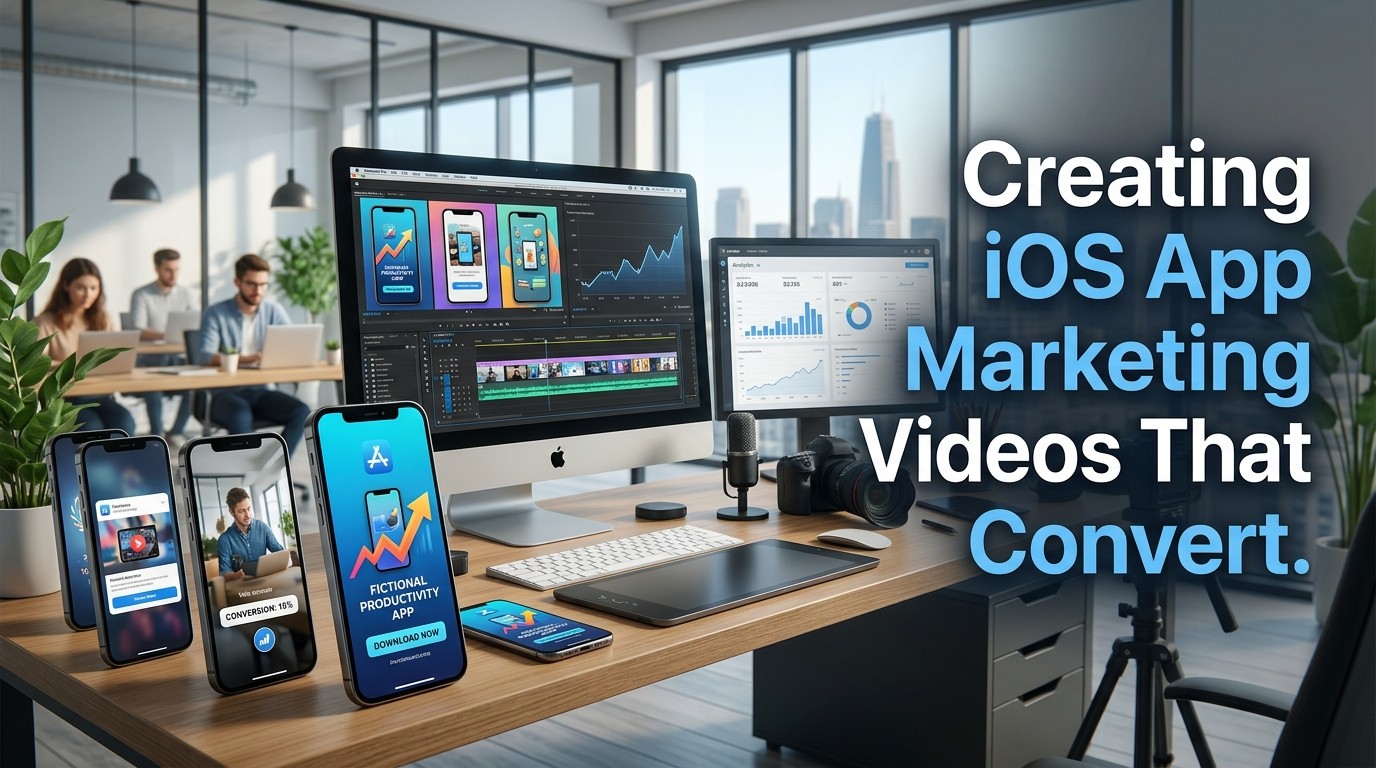
An iOS App Marketing Video should capture attention fast, explain value clearly, and move viewers toward installation by combining strong messaging, crisp visuals, and a simple call to action.
An iOS App Marketing Video is no longer just a nice creative asset. It is one of the fastest ways to show how an app solves a problem, feels in use, and deserves attention in a crowded market. People do not install apps because of generic claims. They install when they can see the product’s value quickly and believe it will fit their needs. That is why video matters so much.
A strong iOS App Marketing Video works because it reduces uncertainty. Instead of asking a viewer to imagine the experience, it shows the interface, the benefit, and the emotional payoff in a few seconds. That matters especially for mobile products, where users often decide quickly whether to tap, scroll, or move on. The first impression has to do real work.
In this guide, you will learn how to plan, script, edit, and optimize video so it converts more effectively. You will also see how strategy, psychology, and distribution work together. The goal is not simply to make a video that looks good. The goal is to make a video that gets watched, remembered, and acted on.
Why iOS app marketing video matters
An iOS App Marketing Video succeeds when it captures attention in the first few seconds. Most viewers do not arrive with patience. They arrive with limited time and many options. That means the opening needs a clear visual hook, a simple promise, and an immediate sense of relevance.
The psychology is straightforward. People trust what they can see. A video that shows the app in action reduces the mental effort required to understand the product. When the viewer can instantly connect the app to a real use case, the message feels more believable. That trust is a major reason video outperforms static claims in many campaigns.
Another reason an iOS App Marketing Video works is emotional clarity. Apps are often sold on speed, convenience, relief, confidence, or enjoyment. Those benefits are hard to express well in text alone. Video lets the viewer see the benefit and feel it at the same time, which improves memorability and response.
What converts and what does not
The best iOS App Marketing Video is not always the most polished one. It is the one that communicates the right value with the least confusion. A common mistake is trying to show too many features at once. That overwhelms the viewer and weakens the main message. Simplicity usually converts better than feature dumping.
A conversion-focused iOS App Marketing Video should answer three questions quickly: what is this app, why should I care, and what should I do next? If one of those answers is unclear, the viewer may leave before taking action. That is why every second matters. Every visual and every line should support one clear objective.
Strong conversion also depends on audience intent. A new user wants a different message from a returning user. Someone discovering the app through search wants different reassurance than someone seeing it in a retargeting ad. A good iOS App Marketing Video accounts for these differences instead of using one generic script everywhere.
Start with the user problem

The most effective iOS App Marketing Video starts with a real pain point. People pay attention when they feel understood. If the opening reflects a situation they recognize, they keep watching because the video feels personally relevant.
Think about the everyday frustration your app removes. Does it save time, reduce errors, simplify a process, or make something more enjoyable? The problem should appear early because it gives the viewer a reason to continue. Without a problem, the app feels abstract. With a problem, the solution becomes meaningful.
This is where many teams get it wrong. They start with the logo, the brand name, or a vague product statement. A much better opening says, in effect, “Here is the situation you know, and here is a better way through it.” That structure is powerful because it mirrors how the brain evaluates usefulness.
Build a conversion-first script
A script for an iOS App Marketing Video should be short, direct, and organized around one outcome. The viewer should not feel like they are reading a brochure. They should feel guided through a simple value story.
A practical structure is: problem, solution, proof, and action. The problem creates relevance. The solution shows the app. The proof gives confidence. The action tells the viewer what to do next. This sequence is easy to follow and easy to adapt.
A strong script also uses natural language. Avoid jargon unless your audience genuinely expects it. In many cases, a plain sentence converts better than a clever one because it is faster to understand. The more quickly the viewer understands the app, the more likely they are to keep watching.
Visual design that supports action
An iOS App Marketing Video should never rely on visuals alone, but the visuals still do a lot of the persuasion work. The app interface needs to be easy to read, the motion needs to be smooth, and the framing needs to focus attention where it matters.
Good visual design helps the viewer understand the benefit without effort. If the app is cluttered on screen, the message weakens. If the interface is clean and the main action is obvious, the brain processes it quickly. That speed matters because short-form viewers decide almost instantly whether a video feels worth their time.
It also helps to use on-screen text sparingly. A few strong words can reinforce the message, but too much text creates friction. The best videos feel balanced: enough visual information to build confidence, but not so much that the viewer has to work to keep up.
Tone and pacing
Pacing shapes emotional response in a major way. An iOS App Marketing Video that moves too slowly loses attention. One that moves too quickly can feel chaotic. The sweet spot is a rhythm that matches the product’s promise. A simple productivity app may need a clean, calm pace. A social app may need more energy.
Tone matters too. If the app is about efficiency, the video should feel efficient. If the app is about delight, the video should feel lively. If the app is about trust, the video should feel calm and credible. When tone and product purpose match, the message feels more natural.
This alignment is one reason an iOS App Marketing Video can outperform a generic ad. It does not just describe the product. It embodies the product’s personality. That creates coherence, and coherence builds confidence.
Hooks that get viewers to stay
The opening hook is one of the most important parts of an iOS App Marketing Video. If the hook is weak, the rest of the video may never be seen. The best hooks are specific, useful, and quickly understandable.
A hook can begin with a pain point, a transformation, a surprising benefit, or a strong visual moment. The key is to make the viewer feel that the next few seconds will be worth their attention. Curiosity works, but only when it leads to clarity.
Strong hooks also respect the viewer’s intelligence. Overhyped openings may attract attention briefly, but they can damage trust. A good iOS App Marketing Video does not need to shout. It needs to make a promise that the rest of the video actually keeps.
Use proof early
People often decide whether to trust a product before they consciously realize they are evaluating it. That is why proof matters so much in an iOS App Marketing Video. Proof can come from interface clarity, social evidence, testimonial snippets, ratings, numbers, or a real before-and-after comparison.
The goal is not to overwhelm. The goal is to reduce doubt. If the viewer sees the app solving a real problem, the benefit becomes more believable. Proof also helps the app appear more mature and dependable.
Even a short testimonial line or a quick result statement can make a difference. The viewer wants to know that other people have found the app useful. That reassurance makes the call to action feel safer.
Structure for a high-converting ad
A simple ad-length iOS App Marketing Video often works best with this sequence: hook, problem, product, benefit, proof, and CTA. This is not a strict formula, but it is a strong starting point.
The hook earns attention. The problem creates relevance. The product shows the fix. The benefit explains the change. The proof reduces hesitation. The CTA tells the viewer what to do next. Each step is connected to the next so the message never feels random.
If you are making several variants, keep the structure but change the opening angle or the proof element. That allows you to test what resonates with different audiences while preserving the basic logic of conversion.
One clear goal per video
An iOS App Marketing Video converts better when it has one primary goal. Trying to generate installs, subscriptions, brand awareness, and social engagement all at once can create a diluted message.
Choose the main action you want. Do you want the viewer to download the app, start a trial, sign up, or learn more? The video should point toward that action at every step. If the CTA is clear, the viewer does not have to guess what comes next.
That clarity is especially important in mobile marketing because attention windows are short. The more direct the path, the better the conversion experience tends to be.
Where editing matters most
Editing is often where an iOS App Marketing Video becomes stronger or weaker. Good editing removes dead space, highlights the best moments, and creates a visual rhythm that keeps attention moving.
Cut anything that does not support the main idea. If a shot does not teach, persuade, or reinforce the brand, it may be dragging down performance. A leaner edit often converts better than a longer one because the viewer is not forced to wait for the point.
Transitions should also feel intentional. The viewer should move from problem to solution without confusion. When editing creates clarity, the message lands faster.
Mobile-first viewing behavior

An iOS App Marketing Video is usually watched on a phone, which changes everything. Small screens reward simplicity. Text must remain readable, interface shots must be large enough to understand, and the pacing must account for quick scanning behavior.
People often watch mobile video with interruptions around them. That means the message should survive partial attention. If the point can only be understood after a long, uninterrupted watch, the video may underperform.
Design for thumb-stopping clarity. Make sure the first frames communicate enough for a viewer to stay. Mobile behavior is not a disadvantage if the video is built for it from the beginning.
How to test different versions
No iOS App Marketing Video should be treated as final forever. Testing helps reveal which messages, visuals, and openings actually convert. Try different hooks, different opening frames, different CTA language, and different lengths.
A/B testing matters because intuition is often wrong. What feels clever to the team may not feel clear to the user. A simpler message may outperform a more creative one. Testing removes guesswork and makes the video more market-driven.
This is where teams sometimes partner with a App Marketing Strategy Firm to align creative choices with broader positioning and user acquisition goals. Strategy can shape which themes are worth testing first.
Tools that help production
The right production tools can make a big difference in speed and quality. A Screen Recorder Plugin is useful when you need to capture app flows, features, and interactions quickly without building every shot from scratch. It helps teams produce clear product footage faster.
The video production workflow becomes even more efficient when teams pair that capture process with a Chrome SEO Extension or similar strategic support. That kind of partner can help connect creative decisions to growth goals instead of treating the video as a standalone asset.
For some brands, a Professional App Marketing Agency is helpful when the app is part of a larger growth strategy and the team needs both media thinking and product storytelling aligned. The video should fit into a broader conversion system, not exist in isolation.
Length and format choices
The ideal iOS App Marketing Video length depends on where it appears. Shorter versions often perform best in ads because the viewer needs a quick reason to keep watching. Longer versions can work on landing pages, app store pages, or remarketing placements where the audience already knows something about the product.
That does not mean longer is always better for detail. It means the format should match intent. If someone is seeing the app for the first time, a tighter cut may be more effective. If they are closer to deciding, a slightly more detailed video can support that decision.
The best practice is to create several versions. One short hook-focused cut, one mid-length explainer, and one deeper conversion cut. That way the same core footage can support multiple placements.
Messaging that feels human
An iOS App Marketing Video performs better when it sounds like a real person talking to another real person. People are suspicious of robotic language, exaggerated claims, and generic branding lines. They respond better to clear, honest, human communication.
That means the copy should sound useful. Focus on how the app helps the viewer, not on how impressive the product team thinks it is. The more the message sounds like a solution, the better it tends to convert.
The human element also includes visual honesty. Show the actual app. Show the real workflow. Avoid making the product feel like a fantasy. Realism builds trust.
Use sound carefully
Sound is easy to overlook, but it influences perceived quality a lot. An iOS App Marketing Video with weak audio or mismatched music can feel less trustworthy even if the visuals are strong.
Voiceover should be clear and confident. Music should support the tone without overpowering it. If there is no voiceover, then the visual sequence has to carry the message even more carefully. Silence can work, but only when the structure is strong enough to stand on its own.
Good sound design creates emotional momentum. It helps the viewer feel that the app is polished and ready to use.
Social proof and credibility
An iOS App Marketing Video often converts better when the audience sees evidence that others value the app. That might be a rating, a user quote, a logo wall, download statistics, or a brief success outcome.
The trick is to keep proof relevant. A random claim may not mean much. A specific result tied to the app’s real benefit usually works better. The viewer is asking, “Will this help me?” Proof should answer that question.
The more believable the credibility signals, the easier the conversion becomes.
Distribution strategy
A great iOS App Marketing Video still needs a good distribution plan. The same video will not perform identically in every context. Ad placements, landing pages, app store preview slots, email campaigns, and social posts all create different expectations.
Think about the audience moment. Is the viewer cold, warm, or close to buying? The answer should influence the cut and CTA. A cold audience may need more clarity up front. A warm audience may need more proof. A very motivated viewer may need a faster path to download.
Distribution is where creative meets behavior. The best conversion results happen when the video fits the moment.
Common mistakes to avoid
A common mistake is overloading an iOS App Marketing Video with feature lists. Features matter, but not all at once. The viewer needs a simple reason to care.
Another mistake is hiding the app too long. The viewer should see the product early enough to understand what is being offered. Waiting too long can lose attention.
A third mistake is using vague language. If the viewer cannot tell what the app does, they will probably not convert.
A fourth mistake is forgetting the CTA. The video may be persuasive, but if the next step is unclear, the opportunity can be lost.
Building trust through consistency
An iOS App Marketing Video converts best when it feels consistent with the app’s landing page, brand, and onboarding experience. If the ad promises one thing and the app feels different, trust weakens.
Consistency also makes the experience feel more professional. The viewer feels reassured when the same message appears across touchpoints. That alignment reduces cognitive friction and makes the decision easier.
Advanced optimization mindset

As the campaign matures, the best iOS App Marketing Video strategy becomes iterative. The team learns which angle performs best, which hook earns attention, and which proof point drives the highest conversion. Then the next version gets smarter.
This is where the creative process starts to look like a system. Ideas are not just “made.” They are tested, refined, and scaled. That is how good marketing teams outperform random content production.
If you are building video as part of a wider growth system, it helps to think in layers: strategy first, creative second, distribution third, and iteration last.
Practical reminders
A strong iOS App Marketing Video should always begin with the user’s problem, because relevance is what earns attention in crowded feeds.
A strong iOS App Marketing Video should keep the interface readable on a phone screen, since mobile viewers decide quickly whether to continue.
A strong iOS App Marketing Video should use one clear call to action, because confusion usually weakens conversion.
A strong iOS App Marketing Video should show the product early, because hiding the app too long reduces trust.
A strong iOS App Marketing Video should keep the message simple, because viewers remember clear value more easily than feature overload.
A strong iOS App Marketing Video should feel consistent with the landing page, because mismatched promises create friction.
A strong iOS App Marketing Video should use believable proof, because credibility reduces hesitation.
A strong iOS App Marketing Video should be tested in multiple versions, because one version rarely wins everywhere.
A strong iOS App Marketing Video should fit the channel it appears on, because cold and warm audiences respond differently.
A strong iOS App Marketing Video should make the benefit obvious in seconds, because attention is the first conversion barrier.
A strong iOS App Marketing Video should invite the next step naturally, because a forced CTA can feel like pressure.
Final checklist before launch
Before launching an iOS App Marketing Video, check whether the opening is clear, the problem is relevant, the product is easy to understand, the proof is believable, and the CTA is direct.
Also confirm the video is readable on a phone, works with sound off if needed, and matches the platform where it will appear. Small details matter because conversion usually happens at the edge of clarity, not at the edge of creativity.
Conclusion
An iOS App Marketing Video converts when it feels clear, useful, and believable from the first few seconds. The best videos do not try to say everything. They focus on one problem, one solution, and one action. They use visuals to reduce uncertainty, sound to build trust, and pacing to keep attention moving. They also fit the moment in which the viewer sees them, whether that is an ad, a landing page, or an app store preview. When the message, the visuals, and the offer all align, the result is more than a pretty video. It is a persuasive asset that helps people understand the app quickly and move toward download with confidence.
Frequently Asked Questions (FAQ)
1. What makes an iOS App Marketing Video effective?
It is effective when it explains the app clearly, shows the value fast, and gives the viewer a strong reason to act.
2. How long should the video be?
It depends on placement, but shorter cuts often work better for ads while longer versions can work on landing pages and app store contexts.
3. Should I show the app early?
Yes. Viewers need to understand what the product is as soon as possible.
4. Do I need voiceover?
Not always, but clear voiceover can improve comprehension and trust if it fits the brand.
5. What should the opening focus on?
The opening should show the user problem or the main benefit quickly so the viewer knows why the video matters.
6. How important is proof?
Very important. Ratings, testimonials, and concrete results reduce hesitation and make the offer feel more credible.
7. Can one video work everywhere?
It can serve multiple placements, but different channels often benefit from different cuts or edits.
8. What is the biggest mistake to avoid?
The biggest mistake is trying to say too many things at once and losing the main conversion message.
9. How do I improve performance over time?
Test hooks, lengths, proof points, and CTA language, then use the results to refine the next version.
10. Why does an iOS App Marketing Video convert better than static content?
It shows the app in action, reduces uncertainty, and helps the viewer understand value faster than text or images alone.